Monday, February 28, 2022

“THE NEW NAME, WRITTEN IN GLORY”


Six centuries before the birth of Christ, the prophet Isaiah foretold that a new name would be given to the people of God. The prophet wrote, “And the nations shall see thy righteousness and all kings thy glory: and thou shall be called by a new name, which the mouth of Jehovah shall name” (Isaiah 62:2). The Lord was going to give his people a new name! This prophecy is fulfilled in Acts. By this time Jesus had come, gave his blood for the sins of the world, and resurrected from the dead. The church had been established and the gospel was being preached among the nations. Thus the stage was set for the giving of this new name, an in Acts 11:26 we read, “The disciples were called Christians first in Antioch”.

The name Christian is not a term of derision. Rather, this is the new name which God gave to His people. It is a name to be worn with joy and with thanksgiving. The apostle Peter wrote, “If a man suffer as a Christian, let him not be ashamed; but let him glorify God in this name” (1 Peter 4:16). A Christian is one who follows the example of Christ both in word and deed. By this behavior one is identified with Christ. We see this from what was said about Peter and John in Acts 4:13“Now as they observed the confidence of Peter and John and understood that they were uneducated and untrained men, they were amazed, and began to recognize them as having been with Jesus.” This is what it means to be identified with Christ. Many people followed after Jesus during His earthly ministry, yet few followed His words and His example. In fact, most feared to be identified with Him.

To be identified with Christ is to be in a covenant relationship with Him. Jeremiah had prophesied of the day when God would “make a new covenant with the house of Israel, and with the house of Judah.” (Jeremiah 31:31). Jesus was the mediator of that new covenant (Hebrews 12:24). His laws would be written upon the mind and heart of His people (Jeremiah 31:33; Hebrews 10:16). This pointed to the fact that their consciences would be purged from sin (Hebrews 10:2; 2 Peter 1:9). Jesus would purge our sins with His blood (Hebrews 1:3). This is why Jesus, after observing the Passover with His disciples, took a cup and said, “this is My blood of the covenant, which is poured out for many for forgiveness of sins” (Matthew 26:28).

Entrance into this covenant relationship is by means of the new birth that Jesus spoke of in John 3 to Nicodemus. The Lord said, “Verily, verily, I say unto thee, Except one be born anew, he cannot see the kingdom of God” (John 3:3). When Nicodemus failed to understand the new birth, Jesus explained it more fully by saying, “Verily, verily I say unto thee, Except one be born of water and the Spirit, he cannot enter into the kingdom of God.” (John 3:5). Notice from John 3:5 that Jesus spoke of the new birth in connection with entering into the kingdom of God. This indicates that the new birth could not occur unless the kingdom of God had been established. Jesus also taught in Matthew 7:21 that entrance into the kingdom was conditioned upon obedience to the will of the Father. He said, "Not everyone that saith unto me Lord, Lord, shall enter into the kingdom of heaven; but he that doeth the will of my Father which is in heaven".

From these texts we learn several things. We see that the new birth is an act of obedience to the will of the Father and that entrance into the kingdom is by obedience. Further we see that entrance into the kingdom is identical with entrance into a covenant relationship. Therefore, entering into a covenant relationship with God is an act of obedience.

Jesus told Nicodemus that he needed to be ‘born anew’. There was something for Nicodemus to obey in being born anew. How would this happen? When would Nicodemus undergo this new birth? It would happen in the manner that Jesus explained to the apostles. The kingdom of God would come ‘with power’ from on high. The apostles were to wait in Jerusalem until this happened. When this power came upon THEM (the apostles); they would preach words of repentance and remission of sins. (Luke 24:47-49). They would explain how remission is connected to the blood of Jesus. Everyone who was saved in the book of Acts was ‘born anew’ in like manner as Nicodemus.

In Acts 10 Cornelius, we find a good moral man who was not a Christian (Acts 10:2, 22). Yet Cornelius had not been ‘born of water and of the Spirit’. An angel of God was sent to tell him ‘words’ THAT PERTAINED TO BEING BORN ANEW (Acts 11:14). He would need to obey these words, like as Nicodemus. Cornelius was told the same words as Nicodemus.

To exercise one’s faith by obedience to these words is to obey the gospel. Those who will be eternally lost are those who do NOT obey the gospel (2 Thessalonians 1:8). While there are many who do not know God, many who know God have not obeyed the gospel commands that pertain to being born anew. Those who have are known in Glory by this new name: Christian.


2/27/22

Saturday, February 12, 2022

“TWO WAYS TO BE OVERTAKEN”


In the days of the prophet Samuel, the people of Israel demanded a king (1 Samuel 8). This demand was a grave act of disobedience. In spite of God’s warnings against this (Deuteronomy 17), it would have been ‘well’ with them had they heeded all that God had spoken through His servants the prophets. But they didn’t listen. What’s more, disobedience characterized the lives of the majority of the nation of Israel after the demand for a king. Because of their persistent disobedience, the messages of the prophets called upon the people to repent. God warned time and again that if they persisted in rejecting His words, that there would be grave penalties. God’s words are never spoken in vain. “For as the rain and the snow come down from heaven and do not return there but water the earth, making it bring forth and sprout, giving seed to the sower and bread to the eater, so shall my word be that goes out from my mouth; it shall not return to me empty, but it shall accomplish that which I purpose, and shall succeed in the thing for which I sent it.” (Isaiah 55:10-11). To ‘overtake’ meant that God would carry out what He purposed (Lamentations 2:17; Jeremiah 44:28-29).

Disobedience is fueled (ignited) by false words. As in Old Testament times, false words abound today. Therefore truth is as rare today as it was then. The responsibility falls upon each of us to distinguish between God’s words and false words. Pleading ignorance is only a feeble attempt to place our blame upon someone else. This was what Adam and Eve did (Genesis 3).

God warned the prophet Ezekiel of those who preached error, prophesying “from their own inspiration”; “following their own spirit”; “false visions”, and “lying divinations” rather than LISTENING “to the word of the Lord.” (Ezekiel 13).

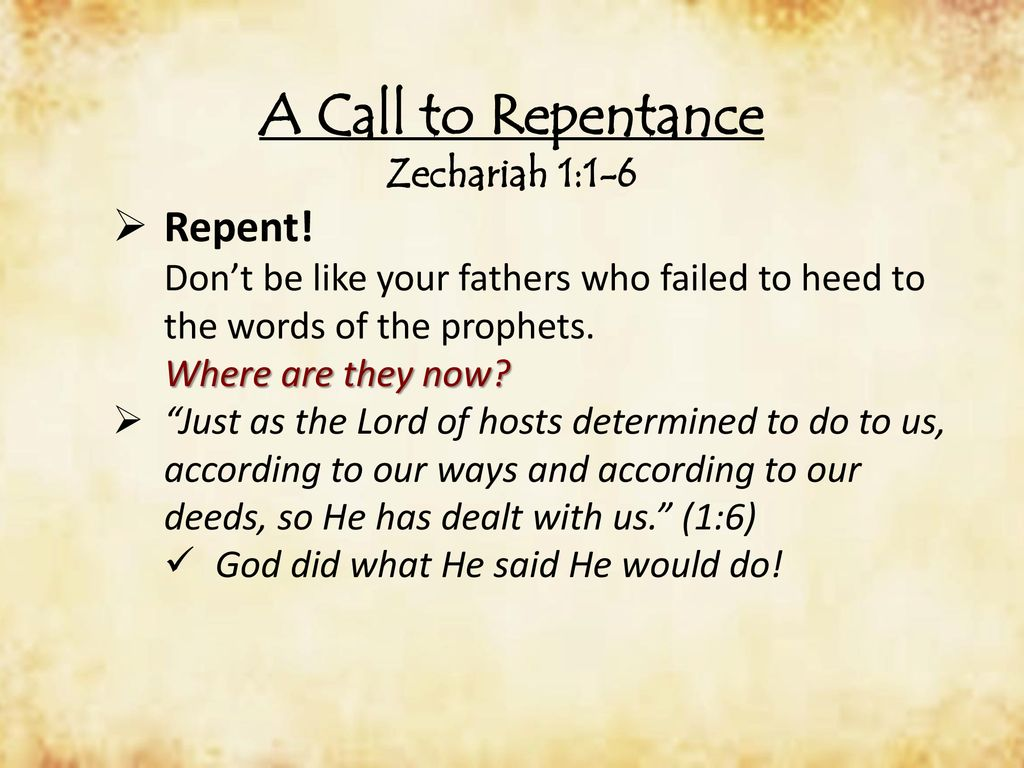
The devastating effect upon those who heard such was seen from the words of another prophet, Zechariah. He opened his message by reminding the people of what had happened to their ancestors when THEY refused to LISTEN to the “word of the Lord” by the prophets. Zechariah wrote, “Thus saith Jehovah of hosts: Return unto me…and I will return unto you, saith Jehovah of hosts. Be ye not as your fathers, unto whom the former prophets cried, saying…return ye now from your evil ways, and from your evil doings: but they did not hear, nor hearken unto me…your fathers, where are they? And the prophets, do they live for ever? But my words and my statutes, which I commanded my servants the prophets, DID THEY NOT OVERTAKE YOUR FATHERS? And they turned and said, Like as Jehovah of hosts thought to do unto us, according to our ways, and according to our doings, so hath he dealt with us.” (Zechariah 1:3-6). We see from this that God’s words overtook those who listened to these false prophets as well as the false prophets.

God’s words are designed to overtake us. The manner in which they will overtake us depends upon our acceptance or rejection of them.  “If at any time I declare concerning a nation or a kingdom, that I will pluck up and break down and destroy it, and if that nation, concerning which I have spoken, turns from its evil, I will relent of the disaster that I intended to do to it. And if at any time I declare concerning a nation or a kingdom that I will build and plant it, and if it does evil in my sight, not listening to my voice, then I will relent of the good that I had intended to do to it.” (Jeremiah 18:7-10). The earlier prophets spoke to the ancestors of the people of Israel of Zechariah’s day. These ancestors were warned to repent of their sins, yet refused. But those to whom Zechariah spoke, repented.

In repentance there is, of course, a submitting of one’s own will to the will of God. It is in the submitting that the ‘overtaking’ of God’s words occurs. Likewise, when God’s words are rejected, one will still be overtaken. It will occur at the appointed time of God’s choosing. This manner of being overtaken is in the form of punishment. Clearly, as in Ezekiel’s day, those who questioned NOT the error, along with those who preached “falsehood” and a “lie”, will perish together. Ezekiel was told to expose them AND their false doctrine (Ezekiel 13:1-8).

As God told the prophet Jeremiah, only a message of truth will open one’s understanding, giving a "heart to know me, that I am the LORD..."; so that wayward people will "return" to God, "...with their whole heart." (Jeremiah 24:7). If we allow God’s words to ‘overtake’ us NOW, in repentance and fruit unto righteousness; THAT DAY, i.e., the day of the Lord will not overtake us as a thief (1 Thessalonians 5:2).


2/12/22

Monday, January 17, 2022

“IGNITE: THE NEED AND PURPOSE”

“IGNITE” has been selected as the theme for this year. The term ignite means to arouse to action. A spark causes a fire to burn. Human emotions can be aroused (ignited) to action in a good way as well as a bad way. Debates and arguments can result from aroused emotions. We find these two reactions in scripture. In Acts 13:50 we read, “the Jews stirred up the devout and honourable women, and the chief men of the city, and raised persecution against Paul and Barnabas.” Then in Exodus 35:21 we read, “And they came, every one WHOSE HEART STIRRED HIM UP, and every one WHOM HIS SPIRIT MADE WILLING…brought the LORD'S offering to the work of the tabernacle of the congregation, and for all his service, and for the holy garments.”

God often stirred up men in these two ways (2 Chronicles 36:22-23; 1 Kings 11:14). When we study the contexts of these incidents, we find that God was the spark to cause men to act out what was within their hearts, good or evil. With Solomon, we find that he had committed sin in going after other gods. As a result, God stirred up an adversary (Hadad), against him as punishment for his sins. With Cyrus, God stirred his heart up and Cyrus granted all God’s people in captivity to return to Jerusalem, which resulted in the temple being rebuilt, fulfilling His promise to save an elect or remnant through which Jesus would come, establishing His church.

This is the purpose for the word of God. It brings out the good or evil in our hearts. It is the needed spark that will arouse our spirit within us to act on our desires. In so doing, we will reveal what is needed to be known about ourselves. We find this from the teaching of Jesus in Mark 4:21-22: “And he said to them, ‘Is a lamp brought in to be put under a basket, or under a bed, and not on a stand? For nothing is hidden except to be made manifest; nor is anything secret except to come to light’.”

We need to know the truth about ourselves NOW, while we have the time and opportunity to serve God. Are we truly serving God, or just giving lip-service? What is the truth about our attitude toward serving God? How will we ever know? It will only be known through our response to things God commands of us. If we REALLY have a desire to serve, we will do as the Israelites did in Exodus 35:21. If not, we will do as a later generation did in Malachi 1:13. While we may assemble and go through the acts of worship, but doing so without a willing heart will only incur the wrath of God upon us.

We find from Deuteronomy 6 the attitude we are to have toward God’s word that will, in turn ensure a blessing from God as He blessed Israel with Cyrus. In verse 5 Moses said to them, “You shall love the Lord your God with all your heart and with all your soul and with all your might.The context in which these words are found clearly prove that loving God is done through obedience to God’s words. Notice Deuteronomy 6:1-7: “Now this is the commandment—the statutes and the rules—that the Lord your God commanded me to teach you, that you may do them in the land to which you are going over, to possess it, that you may fear the Lord your God, you and your son and your son's son, by keeping all his statutes and his commandments, which I command you, all the days of your life, and that your days may be long. Hear therefore, O Israel, and be careful to do them, that it may go well with you, and that you may multiply greatly, as the Lord, the God of your fathers, has promised you, in a land flowing with milk and honey…and these words that I command you today shall be on your heart. You shall teach them diligently to your children, and shall talk of them when you sit in your house, and when you walk by the way, and when you lie down, and when you rise.”

As we consider the matter of ‘igniting’ one another, remember that our stirring up of each other is to be on-going and that our efforts must be directed toward the conversion of the heart. The Hebrew writer put it this way:  “…let us consider how to stir up one another to love and good works, not neglecting to meet together, as is the habit of some, but encouraging one another, and all the more as you see the Day drawing near.” (Hebrews 10:24-25). Let us not be as Israel in Malachi’s day and view our serving God as ‘wearisome’. Rather let us have the attitude of David, “I was glad when they said to me, ‘Let us go to the house of the Lord’.” (Psalm 122:1).

1/17/22

Friday, January 14, 2022

“IS IT FUTILE TO SERVE GOD?”

A new year has begun. Many resolutions have been made. One resolution that would benefit every person is that of serving God. As we take inventory of our lives, we may find that our lives have become stagnant. The people of Zephaniah’s day had become stagnant. Zephaniah said they were,“…men who are stagnant is spirit, who say in their hearts, ‘The LORD will do nothing, either good or bad’.” (Zephaniah 1:12). Because of this, God was bringing punishment upon His people. It begs several questions: How could God’s people become stagnant? WHY would God’s people become stagnant? What factors contributed to this? Perhaps a more important question: Is this mindset prevalent among God’s people today? Let us consider these matters in this article.

Stagnation is a failure to develop, progress, or advance. When water becomes stagnant, a foulness or staleness, emanates results. When people become stagnant, this concept of foulness or staleness is seen in their dullness of hearing and their senses unable to discern right from wrong.

From Zephaniah 1:5-6 we see the characteristics of stagnant behavior in God’s people. They “…bow down and swear to the LORD and yet swear by Milcom.” They had “…turned back from following the LORD, and...not sought the LORD or inquired of Him.”

How had this happened? We find the answer in the record of their own lives. God’s people had persisted in disobedience to the Law of Moses. They were strictly warned not to imitate the idolatrous practices of the Canaanites (Deuteronomy 6:14), yet they did this very thing! They had become “settled” in this way of living. Zephaniah said, “And it shall come to pass at that time, that I will search Jerusalem with candles, and punish the men that are settled on their lees: that say in their heart, The LORD will not do good, neither will he do evil…” (1:12). This describes their complacency. Other prophets gave us similar explanations.

~ Ezekiel wrote, “Son of man, have you seen what the elders of Israel are doing in the darkness, each at the shrine of his own idol? They say, The LORD does not see us; the LORD has forsaken the land” (8:12).

~ Malachi revealed even more insight. He described their complaining and murmuring as follows: “You have wearied the LORD with your words. ‘How have we wearied him?’ you ask. By saying, ‘All who do evil are good in the eyes of the LORD, and he is pleased with them’ or ‘Where is the God of justice’?” (2:17)

~ “You have said, ‘It is futile to serve God. What do we gain by carrying out his requirements and going about like mourners before the LORD Almighty’?” (3:14)

Stagnation is no respecter of persons. Complacency can ‘set in’ today when anyone persists in disobedience. A stagnant life only changes in repentance. The gospel message declares this necessity. When a child is raised in an environment of complacency, it presents the most difficult obstacle to overcome in giving one’s life to Christ. Herein we see the need for the training up of a child in righteousness by both word and example of the parents.

Complacency can return in the life of Christians. When Christians suffer from complacency, they become weary of standing for the truth. Read again Malachi’s record of the words of Israel: ‘It is futile to serve God. What do we gain by carrying out his requirements and going about like mourners before the LORD Almighty?’ (Malachi 3:14). Weariness in well-doing is an ever-present threat. It wears on us. We see the parade-like atmosphere in the religious world about us on the TV and on social media as they praise the Lord for their blessings and prosperity, while we go about “carrying out his requirements, like mourners…” Enticed by the glitter many have sought to incorporate their practices into the worship of the Lord to “liven up” things. They see the proverbial “greener grass” among the denominational ways and desire to be fed with their ‘social’ food! They see the prosperity…the large numbers among them and conclude that there is not ‘justice’ with God. As the Psalmist stated of the wicked in Psalm 94:7“…they say ‘The LORD does not see; the God of Jacob does not perceive’.” God answered with a reply that is still applicable today in Psalm 94:9-13:“He who planted the ear, does he not hear? He who formed the eye, does he not see? He who disciplines the nations, does he not rebuke? The Lord, who teaches man knowledge, knows the thoughts of man, that they are but a breath. Blessed is the man whom you discipline, O Lord, and whom you teach out of your law, to give him rest from days of trouble, until a pit is dug for the wicked.”

1-14-22

Sunday, December 26, 2021

“LITTLE MATTERS”


NOTE: The following article was written by Benjamin Franklin. This Benjamin Franklin (1812-1878) was a descendant in the fourth generation from the brother of the statesman and philosopher, Benjamin Franklin. He became a gospel preacher and preached during the time of the Restoration Movement.

It may seem strange that a human body, weighing one hundred and fifty pounds, would be disturbed by a little thorn in it, not an eighth of an inch long! But, strange as it may appear, it is a fact. And you cannot accustom the body to it by piercing the thorn in deeper and deeper, till the body will become easy and comfortable; but you can in that way produce irritation, then inflammation, then mortification, and then death. Death has been produced in this way many times. He is no friend to the body who continues to push the thorn in deeper and deeper, nor is he who would excuse him in so doing, or encourage him in it. There is but one remedy, and that is to remove the thorn. Even if you have to make the wound much larger than it is, the thorn must be removed, or the end will be death.

There are cases in which a thorn might be pierced into the flesh an inch, and produce no pain or irritation; but they are cases where there is no life in the flesh. A thorn pierced into a dead body will produce no pain or irritation. A dead body has no power to resist it, and will make no effort. This is the reason precisely that a thorn produces no irritation or pain when pierced into certain bodies. They are dead bodies. It is no indication that the body is not alive and in healthy condition, to find it resisting foreign matter, and making an effort to remove obstructions; but when it cannot do this, the body must die. It cannot live and the obstruction remain, at least, only for a short time. But who will permit even a little thorn to remain in his flesh? We care not how little it may be; it is foreign, it is irritating, and, unless removed, will produce death.

It was a little thing for Eve to partake of the forbidden fruit. Thomas Paine inquired, “What harm was there in eating an apple?” This is the watchword with all the unlawful things that people desire to do. “What harm is it?” When we worship according to Scripture we never inquire, “What harm is it?” It is not in doubt, and calls out no such inquiry. It is not under any suspicion. To worship according to Scripture is manifestly right. Why should we lag in anything in doubt, under suspicion, and repulsive to any portion of the body, when we have a divinely-prescribed worship held in no doubt?

It was a little thing for Achan to take a Babylonish garment, some silver, and a wedge of gold, and secrete them in his tent; but when he came to confess, it was not a little matter (Joshua 7:19-26). It was a little matter for Uzza to “put forth his hand to hold the ark;” but he fell dead on account of it (1 Chronicles 13:9). What became of them who offered strange fire on God's altar? “And Nadab and Abihu, the sons of Aaron, took either of them his censer, and put fire therein, and put incense thereon, and offered strange fire before the Lord, which he commanded them not. And there went out fire from the Lord, and devoured them, and they died before the Lord.” (Leviticus 10:1-2). That was a little matter; only slightly tampering with the worship; simply introducing a new element, which the Lord commanded them not, or did not command them. It is a fearful thing to tamper with the worship.

In one word: If “every transgression and disobedience received a just recompense of reward” in God's dealings with men in former ages, “how shall we escape if we neglect so great salvation” (Hebrews 2:2-3)? If God allowed no departures in the typical worship, why should we assume that he will permit it in the worship typified? If everything had to be done according to the patterns given to Moses in the typical dispensation, how can any man infer that we may depart from the substance? We had better take heed now. We may not add anything, nor take any away from what the Lord gave. We may not preach any other gospel, or even pervert the gospel of Christ.

Some of the little matters now among us will be found sufficient to stop the ark of God, and cause more than three thousand to be defeated. If Moses were to address some of our men, he would say to them, as he did to Aaron, “What hath this people done to thee that thou hast brought so great a sin upon them?” or as Joshua said to Achan: “Why hast thou troubled us? The Lord shall trouble thee this day.” Let us hear and live.

12/26/21

Saturday, December 11, 2021

“AND THE DISCIPLES WERE CALLED…”

He was born in Kelvedon, Essex, to a family of clerics. His father and grandfather were Nonconformist ministers (meaning they weren’t Anglicans). At age 15, he broke with family tradition by becoming a Baptist. He attributed this conversion to a sermon heard by “chance”—when a snowstorm blew him away from his destination into a Primitive Methodist chapel. The experience forced him to re-evaluate his idea on, among other things, infant baptism. Within four months he was baptized and joined a Baptist church.

His theology, however, remained more or less Calvinist, though he liked to think of himself as a “mere Christian”. “I am never ashamed to avow myself a Calvinist”, he once said. “I DO NOT HESITATE TO TAKE THE NAME OF BAPTIST, BUT IF I AM ASKED WHAT IS MY CREED, I REPLY, ‘IT IS JESUS CHRIST’.”

Later on, he would write: “I say of the Baptist name, let it perish, but let Christ’s name last forever. I look forward with pleasure, to the day when there will not be a Baptist living. I hope they will soon be gone. I HOPE THE BAPTIST NAME WILL SOON PERISH; BUT LET CHRIST’S NAME ENDURE FOREVER.”

Who was this individual? It was Charles Spurgeon. The question for your consideration is this: “Was Mr. Spurgeon right in the initial statement about the Baptist name; or the latter statement? (Quote is from Spurgeon Memorial Library, Vol. 1, page 168).

“And the disciples were called Christians first in Antioch” (Acts 11:26).

rdb

12/11/21

THOUGHTS ON OUR WORSHIP


Moses told the children of Israel these words regarding their worship when they would live in the land of Canaan: “These are the statutes and rules that you shall be careful to do in the land that the Lord, the God of your fathers, has given you to possess, all the days that you live on the earth. You shall surely destroy all the places where the nations whom you shall dispossess served their gods, on the high mountains and on the hills and under every green tree. You shall tear down their altars and dash in pieces their pillars and burn their Asherim with fire. You shall chop down the carved images of their gods and destroy their name out of that place. YOU SHALL NOT WORSHIP THE LORD YOUR GOD IN THAT WAY.” (Deuteronomy 12:1-4).

There are a number of lessons we can take from this story. We find that it DOES matter HOW God is worshiped. In the second place, we see from the worship of the Canaanites that worship can be wrong! God gave instructions to Cain and Abel, to Noah, and to Abraham regarding how He was to be worshiped. The Law of Moses had instructions for the nation of Israel to follow in their worship. Likewise God has given instructions in the New Testament as to HOW He is to be worshiped, specifically, WHAT acts of worship to render, and HOW to render those acts. While worship commands have changed down through time, one constant has remained: obedience to what God commanded.

This helps us to understand why the Lord’s death is to be observed as well as how often the Lord’s Supper is to be observed. It is why we don’t assemble on Saturday, but rather on Sunday; why animal sacrifices are NOT offered today, whereas they were commanded under the Law of Moses. This also explains other changes in worship today that differs from the worship under the Law of Moses, such as the use of instruments and dancing (Psalm 150:3-4 versus Ephesians 5:19; Colossians 3:16), along with the place of worship (John 4:20-24).

Jesus also pointed out how worship can be in vain because of error in the message. This is seen from His words in Matthew 15:8-9: “...in vain do they worship me, teaching as doctrines the commandments of men.” Let us remember and learn why Moses gave the warning, “YOU SHALL NOT WORSHIP THE LORD YOUR GOD IN THAT WAY.”

God hasn’t left worship up to us, to decide and do as WE please. Let us respect HIS will in the matter of worship, and the spiritual blessings in Christ are ours to be enjoyed, chief of which is the forgiveness of our sins (Ephesians 1:3, 7).

rdb

12/11/21